
DACHSER is transferring its range of logistics services to the digital world. As a company-wide digitalization project, the DACHSER platform is a central building block for fundamentally redesigning the customer experience. At the transport logistic trade fair, customers and interested parties were given their first glimpse of the platform, which will be available to all DACHSER customers from 2024.
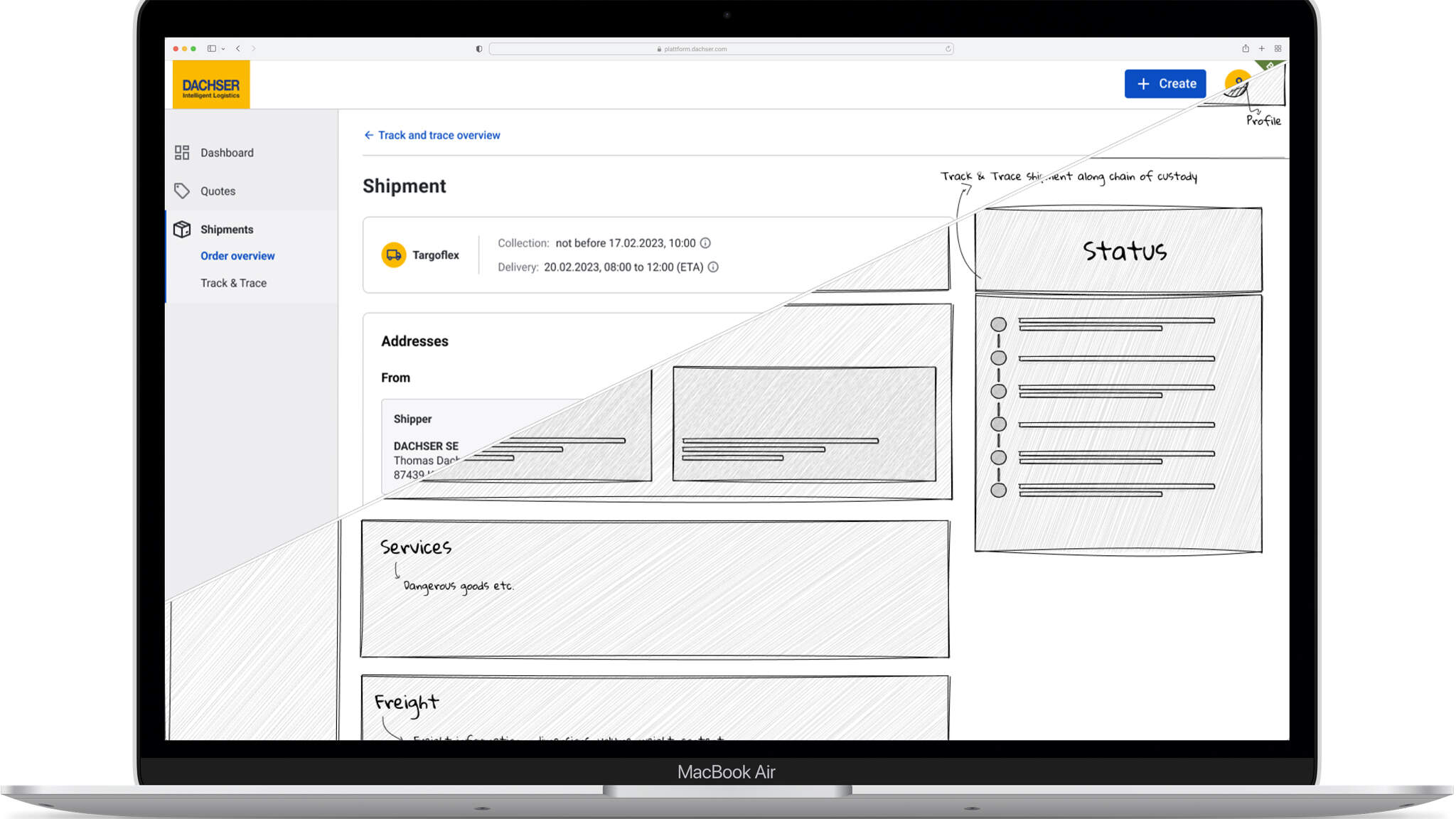
From concept to platform: the interface of the new DACHSER platform
For many years, DACHSER has been developing software and systems in-house that are tailored entirely to the needs of its customers. The DACHSER platform is a logical continuation of this philosophy. The platform is currently being developed in an agile project setup, i.e. in direct exchange with selected pilot customers.
Transparent one-stop solution
The DACHSER platform brings together the services of the Road Logistics and Air & Sea Logistics business fields in a user-friendly, modern interface. Supplemented by innovations such as end-to-end tracking across all freight routes, this creates a customized, digital one-stop solution for customers. DACHSER is thus taking a major step toward completely transparent flows of goods and data, especially with regards to intercontinental transports using different modes of transport.
The DACHSER platform is developed iteratively and in direct exchange with customers.
Product development is taking place within iterative testing and development phases. Since the start of the project, intensive research phases have been used to query customer needs and obtain feedback on product designs. Since April 2023, pilot customers have already been working with a first version of the platform. All research results are always incorporated into the subsequent development phase. This way of thinking and working is an expression of an agile, digital mindset that DACHSER is promoting throughout the company as part of its digitization strategy.
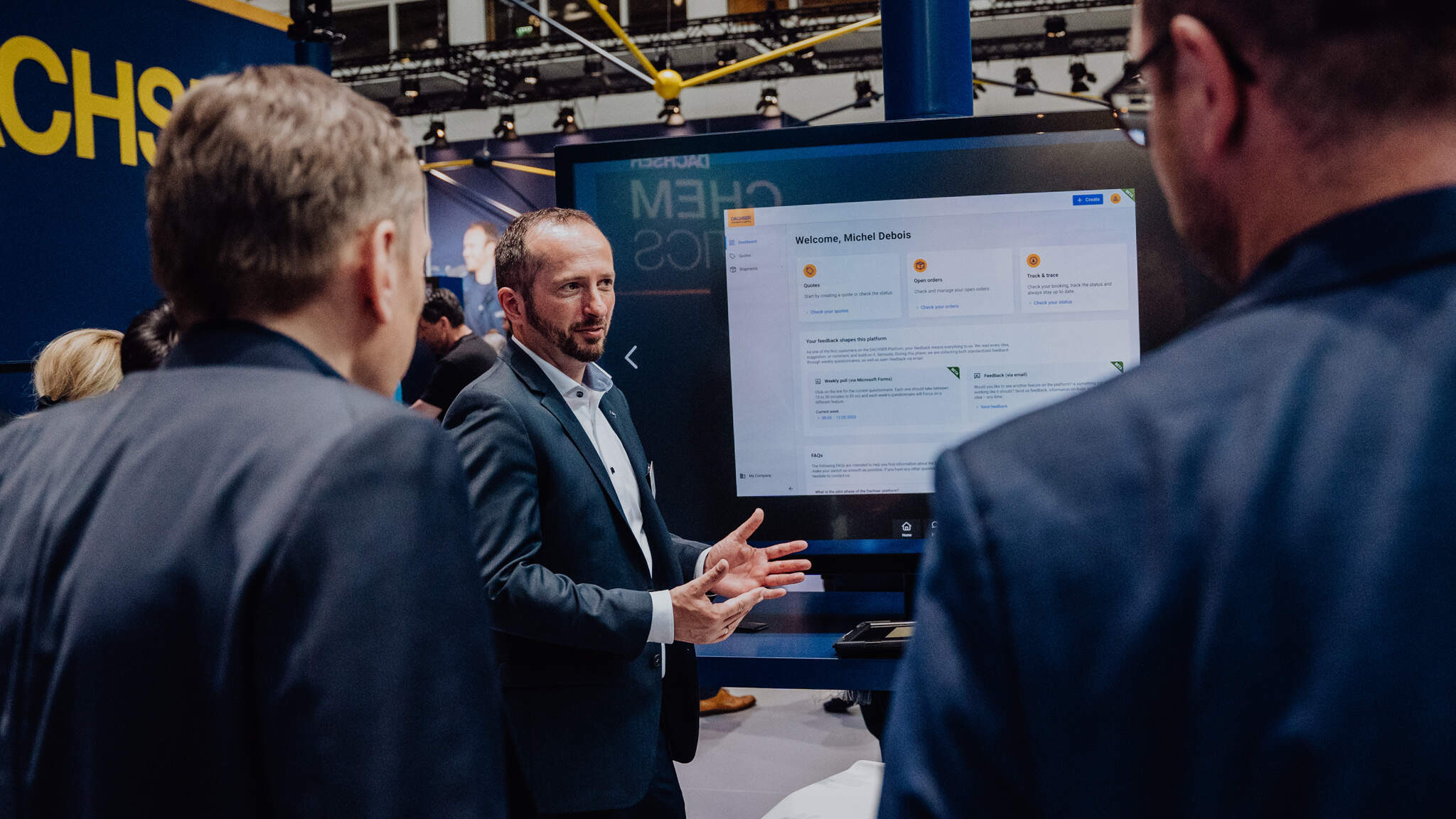
Ralf Messing, Team Leader eLogistics Consulting at DACHSER, demonstrates the dashboard at the transport logistic trade fair in Munich.
Highlight at transport logistic 2023
Insights into the new platform were offered for the first time at the leading transport logistic trade fair in Munich. DACHSER customers, interested parties, and the media were able to learn about the project's vision, development, and timeline roadmap on interactive screens.
Due to the ongoing disruption of the sea freight market, the after-effects (container shortages and frequent port congestion) continue to impact global supply chains. Below, we provide an update on all developments to minimize potential disruptions to your business.
Right at the beginning of the corona pandemic, a distribution company based in northern Spain aligned itself with the new market requirements: in 2020, Pharmediq enlisted DACHSER’s help to transport more than 100 million masks and other protective equipment to locations in Spain and other European countries.
APAC countries signed world's largest free trade agreement
On November 15, 2020, leaders from 15 Asia Pacific nations came to an agreement to form a free trade bloc under the Regional Comprehensive Economic Partnership (RCEP). The agreement is intended to facilitate trades among the member countries by removing tariffs and stimulate the economy amid the COVID-19 pandemic.
Main points at a glance:
RCEP is a free trade agreement in the Asia-Pacific region.
Fifteen countries signed the agreement including Australia, Brunei, Cambodia, China, Indonesia, Japan, Laos, Malaysia, Myanmar, New Zealand, the Philippines, Singapore, South Korea, Thailand, and Vietnam.
With the participation of the 15 countries, they have formed the world's largest free trade zone, covering about 30% of the world's population and nearly 30% of global GDP.
China’s presence notably increases the impact of the agreement and boosts the total GDP of the RCEP member countries.
India did not join the partnership over concerns that cheap import products might pose a harm to local producers.
The new free trade zone is bigger than the US-Mexico-Canada Agreement (USMCA) and the European Union.
The RCEP will reduce taxes on most goods over a 20-year period, streamline customs procedures, regulates the field of intellectual property and digital trade and replace a number of bilateral trade agreements in the region with one set of rules.
Some benefits are expected to be seen in 2021 once participate nations complete their domestic ratification procedures.
What does it mean to the global supply chain?
The RCEP is expected to eliminate a range of tariffs and quotas on most of the goods traded within the region over a 20-year period.
The "rules of origin” may have the biggest impact. Under RCEP, parts from any member nation would be treated equally, this gives companies in RCEP member countries an incentive to look for supplier within the region.
Many of the RCEP member countries already have bilateral free trade agreements between each other, RCEP would streamline the various overlapping preferential terms. This reduces complexity and reduce costs for businesses.
China, Japan and South Korea are the traditional key players for electronics, automotive, textiles and garments industries, having them in the RCEP would ensure supply chain stability to ASEAN countries.
It gives an incentive for companies to look for supplier within the RCEP member countries, thereby laying the foundation for enabling an accelerated GDP growth within the region.
As RCEP will further fuel the ongoing manufacturing shifts within Asia, it not only affects companies within the member countries but is also relevant to any companies worldwide who have business in the region.
Feel free to reach out to us at dachser.apac-asl@dachser.com to know more about the new free trade agreement. Together we can review your current supply chain locations and identify steps to grasp the greatest benefits under the impact of RCEP.
Major airports are still facing bottlenecks in cargo handling. Airlines have to reduce freighter capacities for urgent maintenance, while the market strives for additional capacities around the globe.
Congested Airport Situation
At world's major airports, high freight volumes are currently seen. The reason is that more and more airlines are bundling flights at hub airports. The same applies to forwarders who are increasingly consolidating their activities.
In addition, the number of passenger freighter so called ‘PREIGHTERs’ is increasing every week. For these flights, the loading and unloading process is much more time-consuming due to the sometimes loose packaging. This affects all ground handling (trucking, on-/offloading, palletizing) processes at large airports around the globe.
Global Capacity Situation
The already mentioned global cargo situation and the continuing high demand for capacity have a significant impact on the yield of the major trade lanes, which is stable on a high level. Furthermore, access to capacity at adequate price levels is almost impossible.
Necessary to allude here is that in the next few weeks a decline of freighter activities will become visible in the market, as many of the already obsolete aircrafts are in urgent need of a maintenance C or even D check. Inevitably, this will lead to less capacity in the market, higher demand and therefore higher costs.
With the passenger freighters, the forwarders are trying to counteract this bottleneck. However, the number of available aircrafts has also reached its limits now.
Oil Price Development
Another important topic is the development of the oil price. In the second quarter of 2020, the oil price was at a low of 17,54 USD, in February 2021, it is at 64,17 USD. The price has almost tripled. The high oil price has a direct impact on the fuel surcharges of the commercial airlines and, for example, also on the cost structure in the charter contracts of DACHSER’s dedicated flight activities.
The cost structure is tied to the development of the global oil price. Therefore, the development of the global oil price becomes an everyday topic.
Read the PDF below for the current Global Capacity Situation and Oil Price Development.
In case you need any additional information related to DACHSER’S air freight services and the current market development, please do not hesitate and contact your local DACHSER contact.